
Herniated Disc: Symptoms, Causes, Types and Evidence-Based Treatment
A herniated disc is a spinal condition in which material from an intervertebral disc extends through its outer layer. Depending on its location and severity, it may cause back or neck pain, numbness, tingling, muscle weakness, or pain that travels into an arm or leg.
Although a herniated disc can sound serious, it does not automatically require surgery. Many people improve with appropriate non-surgical care, and some herniated discs gradually decrease in size over time.
Understanding the difference between a herniated disc and a bulging disc, recognising potential warning signs, and knowing when to seek professional assessment can help you make informed decisions about your spinal health.
At Wave Chiropractic & Wellness in Toowoomba, Queensland, people experiencing back pain and related musculoskeletal symptoms can explore appropriate assessment and care options. The most suitable approach depends on individual symptoms, clinical findings, and whether further medical investigation is necessary.
This guide explains the types of disc herniation, common symptoms, diagnostic methods, treatment options, and what scientific research says about recovery.
What Is a Herniated Disc?
A herniated disc occurs when part of the soft inner material of an intervertebral disc pushes through a weakened or damaged area of its tougher outer layer.
Intervertebral discs sit between the vertebrae and help distribute loads, absorb forces, and allow the spine to move. Each disc contains a soft, gel-like centre called the nucleus pulposus and a fibrous outer ring called the annulus fibrosus.
When disc material extends beyond its normal boundary, it may irritate nearby spinal nerves. However, a herniation does not always cause pain or other symptoms.
A disc herniation can occur in the cervical spine, which is the neck, or the lumbar spine, which is the lower back. Thoracic disc herniations in the middle portion of the spine are less common.
The term ruptured disc is sometimes used to describe a herniated disc, although the precise structural changes can vary. Similarly, disc prolapse is another term used in some medical settings.
A diagnosis should not be based on symptoms alone. Back pain, neck pain, and nerve-related symptoms can have several possible causes, so a clinical assessment is important.
Read more about spinal disc problems and their symptoms.
What Is the Difference Between a Herniated Disc and a Bulging Disc?
The terms bulging disc and herniated disc are related, but they do not describe exactly the same structural change.
A bulging disc generally extends beyond its usual boundary over a broader area. A herniated disc describes more localised displacement of disc material, which may involve protrusion or extrusion.
| Disc type | What it means | Important consideration |
| Bulging disc | A broader extension of the disc beyond its usual margins | May occur without symptoms |
| Disc protrusion | A localised herniation in which the base of the displaced material is wider than its outward extension | Symptoms depend on the location and surrounding structures |
| Disc extrusion | Disc material extends beyond the disc space, with a narrower connection to its origin than its outward component | May sometimes undergo substantial spontaneous regression |
| Disc sequestration | A fragment of disc material has separated from the main disc | Requires interpretation alongside symptoms and clinical findings |
These distinctions are primarily anatomical and radiological. A larger-looking disc abnormality does not necessarily mean more severe pain.
Bulging Disc vs Herniated Disc Symptoms
A bulging disc and a herniated disc may produce similar symptoms if either affects nearby nerves. Both can also be present without noticeable discomfort.
Potential symptoms include:
- Localised back or neck pain.
- Pain extending into the buttocks, legs, shoulders, or arms.
- Tingling or pins and needles.
- Numbness in an affected area.
- Muscle weakness when nerve function is affected.
The location and pattern of symptoms can help guide assessment, but they cannot reliably establish the exact disc abnormality without considering the clinical findings.
For more information, read about slipped disc symptoms and treatment.
What Causes Disc Herniation?
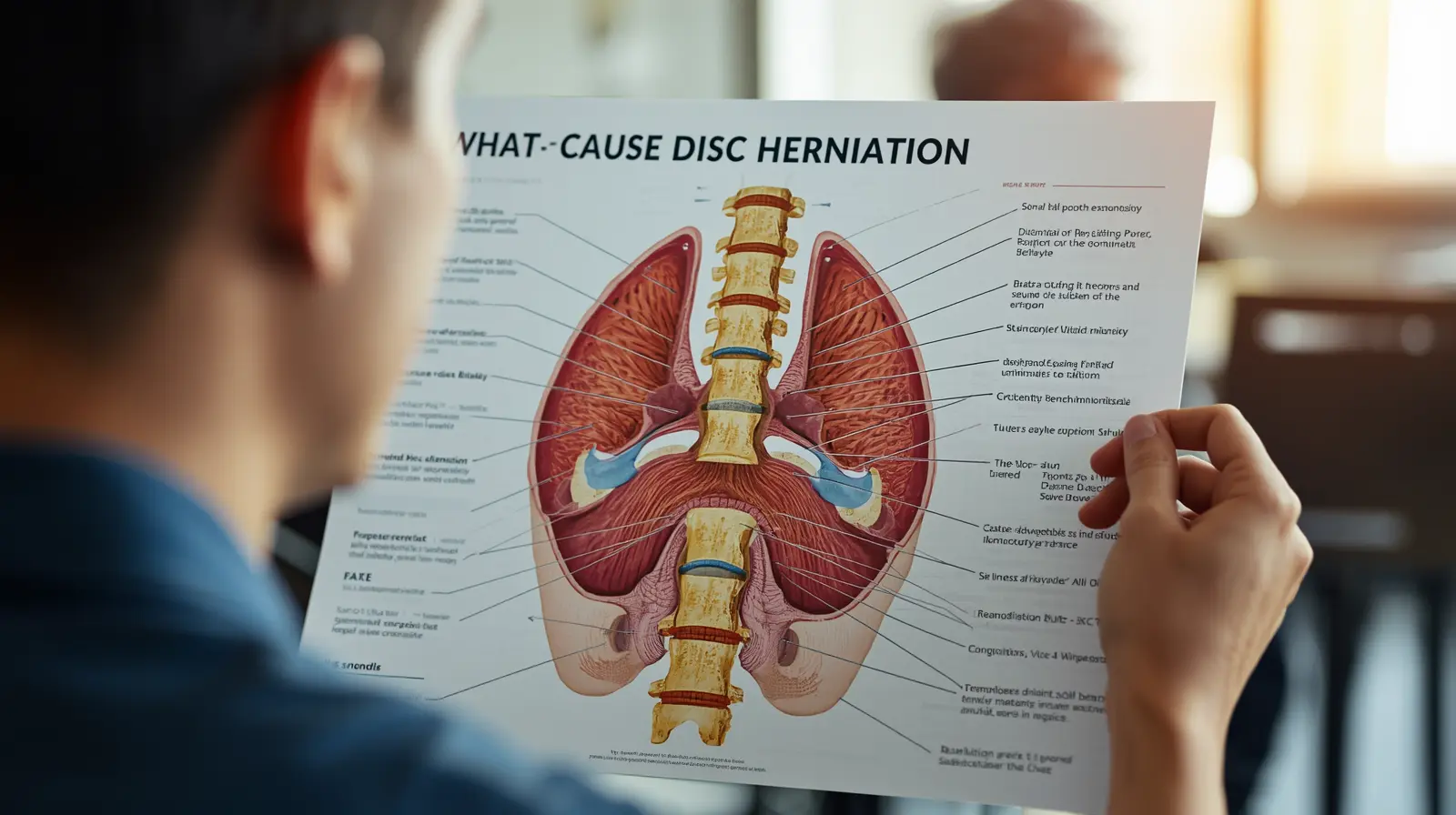
Disc herniation can develop through a combination of age-related changes, physical loading, and individual risk factors. Sometimes symptoms begin after a specific movement, while in other cases they develop gradually.
1. Age-Related Disc Changes
Spinal discs change as people get older. They may lose some of their water content and become less flexible, making certain structural changes more likely.
However, age-related disc changes do not automatically cause pain or disability.
2. Repetitive Lifting and Bending
Repeated lifting, bending, and twisting can place mechanical demands on the spine. A particular movement may trigger symptoms in someone with an existing disc abnormality, although it is not always possible to identify one activity as the cause.
3. Sudden Physical Strain
Some people notice symptoms after lifting a heavy object, a sporting activity, or an unexpected movement. This does not necessarily mean the disc was previously healthy or that the activity alone caused the herniation.
4. Smoking and Other Health Factors
Smoking is associated with poorer spinal disc health. Other factors, including occupational demands, general health, and previous injuries, may also influence risk.
Maintaining physical activity, building strength gradually, and using sensible lifting techniques can support general spinal health, but no prevention strategy eliminates the risk entirely.
Read more about lower back pain that radiates into the leg.
What Are the Symptoms of a Herniated Disc?
Herniated disc symptoms vary according to the affected spinal region, the direction of the herniation, and whether nearby nerves are irritated or compressed.
Some people experience localised discomfort, while others develop symptoms that extend away from the spine.
Lower Back Pain and Leg Symptoms
A lumbar herniated disc may cause lower back pain or discomfort that travels into the buttocks, thigh, calf, or foot.
When a lumbar disc affects a nerve root, it can contribute to sciatica. The pain may feel sharp, burning, shooting, or electric, and it may be accompanied by tingling or numbness.
However, not every case of sciatica is caused by a herniated disc, and not every lumbar disc herniation causes sciatica.
Read more about sciatica pain and its possible causes.
Herniated Disc in the Neck
A cervical disc herniation may cause neck pain, but symptoms can also extend into the shoulder, arm, or hand if a nerve root is affected.
Possible symptoms include:
- Neck stiffness or discomfort.
- Pain travelling into the shoulder or arm.
- Tingling or numbness in the fingers.
- Weakness in particular arm or hand muscles.
A cervical disc problem can sometimes affect the spinal cord rather than an individual nerve root. Symptoms such as difficulty with balance, changes in hand coordination, or problems walking require prompt medical assessment.
Read more about neck pain and its possible causes.
Can a Herniated Disc Cause Symptoms Without Back Pain?
Yes. Some people experience nerve-related symptoms without substantial localised back pain. Others have disc abnormalities on MRI but no symptoms at all.
This is why a diagnosis should consider the person’s history, examination findings, and imaging where appropriate rather than relying on a scan result alone.
How Is a Herniated Disc Diagnosed?
Diagnosing a herniated disc usually begins with a clinical history and physical examination.
A healthcare professional may ask when symptoms began, where the pain travels, whether there is numbness or weakness, and which activities make the symptoms better or worse.
The examination may include assessment of:
- Spinal movement and functional limitations.
- Muscle strength.
- Sensation and reflexes.
- Signs of nerve irritation.
- Walking, balance, and coordination when relevant.
When Is an MRI Needed?
Magnetic resonance imaging (MRI) can show spinal discs, nerve roots, and other soft tissues. It may be useful when symptoms persist, significant nerve involvement is suspected, or imaging would affect decisions about treatment.
However, an MRI is not necessary for every episode of back or neck pain.
A systematic review published in 2015 examined ten studies of classification systems for lumbar disc herniation and nerve-root compression. It highlighted the importance of consistent terminology and correlating imaging findings with clinical symptoms.
This matters because a scan can identify a structural abnormality without proving that the abnormality is responsible for the patient’s pain.
X-rays do not directly show herniated disc material, although they may help assess certain bone-related problems. Other investigations may be considered when the clinical situation warrants them.
Can a Herniated Disc Heal on Its Own?
Many herniated discs improve without surgery. Symptoms may settle as inflammation decreases, surrounding tissues adapt, and the body gradually breaks down and resorbs some displaced disc material.
However, symptom improvement and structural changes on imaging are not identical. A person may feel better even when some disc abnormality remains.
What Does the Research Say About Natural Disc Regression?
A 2015 systematic review published in Clinical Rehabilitation examined 31 studies of lumbar disc herniation managed without surgery. In the subset of studies suitable for pooled estimates, the researchers reported spontaneous regression rates of approximately:
| Disc morphology | Reported spontaneous regression |
| Bulging disc | 13% |
| Disc protrusion | 41% |
| Disc extrusion | 70% |
| Disc sequestration | 96% |
These figures describe regression seen on follow-up imaging in selected study populations. They should not be interpreted as the probability that any individual will recover completely or become pain-free.
A later systematic review and meta-analysis, published in 2023, reported broadly similar findings: regression was more likely in extruded and sequestered discs than in bulging discs and protrusions.
The findings demonstrate that disc material can sometimes decrease naturally. They do not mean that a person should ignore persistent pain, progressive weakness, or other concerning symptoms.
What Are the Treatment Options for a Herniated Disc?
The appropriate disc herniation treatment depends on symptom severity, the location of the affected disc, neurological findings, and the person’s overall health.
Many people begin with non-surgical management. Others may require specialist investigation or surgical treatment.
1. Activity Modification
Remaining gently active is generally preferable to prolonged bed rest for uncomplicated back pain.
Walking, changing position regularly, and temporarily modifying aggravating activities may help maintain mobility while symptoms settle.
Avoid movements that significantly worsen radiating pain or produce new neurological symptoms. Seek professional advice if normal activities become increasingly difficult.
2. Physiotherapy and Rehabilitation
A physiotherapist may recommend an individualised exercise programme based on the person’s symptoms and functional limitations.
Depending on the assessment, rehabilitation may include:
- Gradual strengthening exercises.
- Mobility exercises.
- Movement-control training.
- Functional rehabilitation.
- Advice on returning to work, exercise, and daily activities.
Disc herniation treatment physiotherapy should be tailored to the person rather than based on a universal routine. Some movements may help one patient but aggravate another.
People experiencing progressive weakness or other neurological warning signs need medical assessment rather than simply increasing their exercise programme.
3. Medication and Symptom Management
A healthcare professional may discuss medication or other approaches to managing pain. The suitability of any medicine depends on individual medical history, potential side effects, and other medications being taken.
Heat or cold may provide temporary comfort for some people, but neither physically pushes a herniated disc back into place.
4. Chiropractic Care
Chiropractic care may be considered for selected people with musculoskeletal back or neck pain. Whether it is suitable for someone with a confirmed or suspected disc herniation depends on the clinical findings and potential risks.
An appropriate assessment should consider symptom patterns, relevant neurological signs, medical history, and whether referral for further investigation is necessary.
At Wave Chiropractic & Wellness, people can explore the clinic’s lower back pain care and neck and shoulder pain services.
These services should not be interpreted as a guarantee that a herniated disc will be reversed, that nerve compression will be resolved, or that surgery will be avoided. Some manual techniques may be unsuitable for particular disc conditions, especially when significant neurological problems are suspected.
5. Injections and Specialist Treatment
In selected cases, a medical specialist may consider an injection to help manage pain associated with an irritated nerve. The potential benefits and risks depend on the diagnosis and individual circumstances.
Injections do not repair the disc itself and may not provide lasting relief for everyone.
6. When Is Surgery Considered?
Surgery may be considered when symptoms remain substantially disabling despite appropriate non-surgical care or when significant nerve compression requires intervention.
A lumbar microdiscectomy, for example, removes the portion of disc material responsible for compressing a nerve.
Urgent specialist treatment may be necessary when a disc herniation causes serious neurological complications. The decision to undergo surgery should be based on clinical assessment, imaging where appropriate, and discussion of expected benefits and risks.

How Long Does Recovery From a Herniated Disc Take?
Recovery varies considerably. Some people improve over several weeks, while others experience symptoms for months or longer.
Factors that may influence recovery include:
- The location and morphology of the disc herniation.
- Whether a nerve root or the spinal cord is affected.
- The severity of pain and functional limitations.
- General health and previous spinal problems.
- The response to an appropriate management plan.
The goal of treatment is not simply to change the appearance of a disc on a scan. It is also to improve pain, function, strength, and the ability to carry out everyday activities safely.
If symptoms are not improving, are repeatedly returning, or are affecting sleep, work, or mobility, seek a clinical review.
Read more about how to sleep with sciatica.
When Should You Seek Urgent Medical Attention?
Some symptoms may indicate serious nerve compression or another condition requiring urgent medical assessment.
Seek emergency care if you experience:
- New difficulty urinating or inability to urinate.
- Loss of bladder or bowel control.
- Numbness around the groin, genitals, or inner thighs.
- Sudden or progressive weakness in one or both legs.
- New severe problems with walking or coordination alongside concerning spinal symptoms.
These symptoms can indicate cauda equina syndrome or another serious neurological condition. In Australia, call 000 for an ambulance if emergency symptoms occur.
Do not wait for a routine chiropractic or physiotherapy appointment when emergency warning signs are present.
Frequently Asked Questions About Herniated Discs
Is a herniated disc the same as a ruptured disc?
The terms are often used interchangeably, but the precise structural changes can vary. A healthcare professional may use more specific terminology based on clinical findings and imaging.
Can a bulging disc turn into a herniated disc?
Disc bulging and herniation describe different structural patterns. They should not automatically be viewed as consecutive stages in every person. The interpretation depends on the anatomy, symptoms, and imaging findings.
Can a herniated disc affect the neck and back?
Yes. Disc herniation can occur in both the cervical and lumbar spine. Cervical herniations may affect the neck, shoulder, arm, or hand, while lumbar herniations may affect the lower back, buttocks, and legs.
Does a herniated disc always require surgery?
No. Many people improve with conservative management. Surgery is considered when the clinical situation warrants it, such as persistent disabling symptoms or significant neurological compression.
Can exercise help a herniated disc?
Appropriate exercise can support mobility and function for many people, but the right programme depends on the diagnosis and symptoms. Exercises that increase radiating pain, numbness, or weakness should not be forced.
Can a chiropractor treat a herniated disc?
Chiropractic care may be appropriate for selected musculoskeletal presentations, depending on the clinical assessment. It does not guarantee that a herniated disc will return to its original position, and serious neurological symptoms require medical evaluation.
Final Thoughts
A herniated disc is a structural change that can affect the neck or lower back and may cause pain, numbness, tingling, or weakness when nearby nerves are involved. However, not every disc herniation causes symptoms, and imaging findings must be interpreted in context.
Research indicates that some lumbar disc herniations can regress naturally, particularly extrusions and sequestrations. Many people improve without surgery, although recovery varies and some cases require specialist care.
Understanding the difference between a bulging disc and a herniated disc, recognising warning signs, and choosing an appropriate treatment plan can help people make informed decisions about their spinal health.
For people in Toowoomba experiencing persistent back or neck pain, Wave Chiropractic & Wellness provides information about its musculoskeletal care services. The appropriate next step depends on the individual’s symptoms and clinical findings, with medical referral taking priority when required.
References
- World Federation of Neurosurgical Societies — Lumbar Disc Herniation: Epidemiology, Clinical and Radiologic Diagnosis Recommendations (2024)
- Chiu et al. — The Probability of Spontaneous Regression of Lumbar Herniated Disc: A Systematic Review (2015)
- Rashed et al. — Systematic Review and Meta-Analysis of Predictive Factors for Spontaneous Regression in Lumbar Disc Herniation (2023)
- Li et al. — How Should We Grade Lumbar Disc Herniation and Nerve Root Compression? A Systematic Review (2015)
- Mayo Clinic — Herniated Disk: Symptoms and Causes
- Cleveland Clinic — Herniated Disk: Symptoms and Treatment
- Healthdirect Australia — Back and Spinal Disorders
- NHS — Slipped Disc
Medical disclaimer: This article provides general educational information and does not replace individual medical assessment, diagnosis, or treatment advice. Clinical recommendations should be reviewed by a suitably qualified healthcare professional before publication.

Elemmentor Box
Dr. Hussein
Chiropractor & Director
Is an esteemed chiropractor renowned for his innovative approach to chronic pain management and the transformative power of chiropractic care on brain function
Recent Posts
Degenerative Disc Disease: Symptoms, Causes, Treatment & 7 Relief Tips
Herniated Disc vs Bulging Disc: Symptoms, MRI and Treatment
Bulging Disc: Symptoms, Causes, Treatment and Recovery
Categories