
Herniated Disc vs Bulging Disc: Symptoms, MRI and Treatment
When comparing a herniated disc vs bulging disc, it is important to understand how each condition affects the structure of the spine, whether nearby nerves are irritated, and what the findings mean for your symptoms. Although the terms are sometimes used interchangeably, they can describe different patterns of disc displacement.
A bulging disc generally extends beyond its usual boundary over a broader area, whereas a herniated disc involves more localised displacement of disc material. However, the terminology used in MRI reports can vary, and the size of a disc abnormality does not necessarily determine how much pain a person experiences.
At Wave Chiropractic & Wellness in Toowoomba, Queensland, understanding these differences is relevant to people experiencing lower back pain, neck discomfort, or sciatica-like symptoms. This guide explains the differences, common symptoms, MRI findings, treatment options, and when professional assessment is important.
What Is a Bulging Disc?
A bulging disc occurs when an intervertebral disc extends beyond its normal outer boundary. Spinal discs sit between the vertebrae and help distribute loads while allowing the spine to move.
Each disc contains a soft, gel-like centre called the nucleus pulposus and a stronger outer layer called the annulus fibrosus. With ageing and other contributing factors, a disc may lose some of its flexibility and develop structural changes.
In a bulging disc, the outer contour extends beyond its expected boundary, often across a relatively broad portion of the disc circumference. This does not necessarily mean that the outer layer has torn or that the inner material has escaped through a defect.
What Causes a Bulging Disc?
Several factors may contribute to disc bulging, including:
-
Age-related changes in disc structure.
-
Repeated loading and mechanical stress.
-
Previous spinal injuries.
-
Genetic factors affecting disc health.
-
Changes associated with disc degeneration.
These factors do not mean that a particular activity inevitably causes a bulging disc. Disc changes can develop gradually, and their presence does not always explain a person’s pain.
What Does a Bulging Disc Feel Like?
A bulging disc may cause no symptoms at all. When symptoms occur, they depend on its location and whether surrounding structures or nerves are affected.
Possible symptoms include:
-
Localised lower back or neck discomfort.
-
Stiffness or restricted movement.
-
Pain that worsens with certain positions or activities.
-
Pain travelling into the buttock, leg, shoulder or arm.
-
Tingling, numbness or weakness when nerve involvement occurs.
It is important not to diagnose a disc problem based on symptoms alone. Muscle strain, joint problems and other conditions can produce similar discomfort.
Read more about lower back pain and its possible causes.
What Is a Herniated Disc?
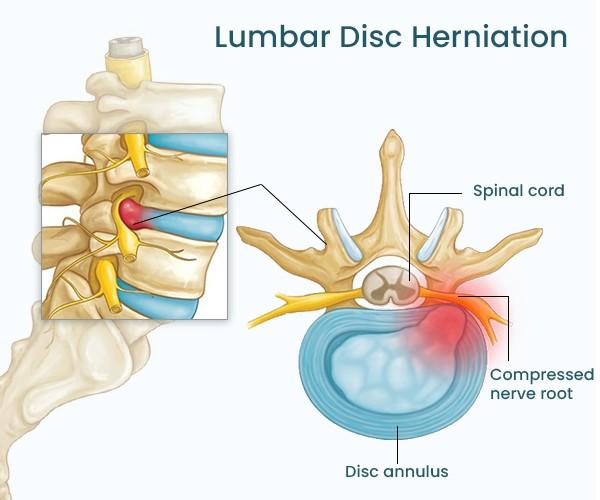
A herniated disc occurs when disc material moves beyond its normal boundary through a weakened or disrupted outer layer. Depending on the pattern of displacement, the material may protrude or extend further through the outer tissue.
A herniated disc can occur in the lumbar spine, which is the lower back, or the cervical spine, which is the neck. The location matters because symptoms depend partly on which nearby nerve structures are affected.
What Causes a Herniated Disc?
A herniated disc may develop through a combination of structural changes and mechanical loading. Contributing factors can include:
-
Age-related weakening of disc tissue.
-
Repetitive bending, lifting or twisting.
-
Sudden loading or injury.
-
Existing degenerative disc changes.
-
Individual differences in disc structure and susceptibility.
A herniation does not always result from one obvious injury. It can also develop in a disc that has gradually changed over time.
What Are the Symptoms of a Herniated Disc?
Some people with a herniated disc experience no symptoms, while others develop significant discomfort or neurological symptoms.
Possible symptoms include:
-
Lower back pain.
-
Neck pain.
-
Pain radiating down a leg or arm.
-
Tingling or numbness.
-
Muscle weakness.
-
Reduced mobility or difficulty performing everyday activities.
A lumbar herniation may irritate a nerve root and contribute to sciatica. A cervical herniation may cause symptoms extending from the neck into the shoulder, arm or hand.
However, the presence of a herniated disc on an MRI does not prove that it is responsible for every symptom.
Read more about herniated disc symptoms and treatment.
Herniated Disc vs Bulging Disc: Key Differences
The most useful way to compare these conditions is to look at the structure of the disc, the pattern of displacement, the potential effect on nerves and the clinical findings.
| Feature | Bulging disc | Herniated disc |
|---|---|---|
| Structural change | Broader extension beyond the disc’s normal boundary | More localised displacement of disc material |
| Outer disc layer | May remain intact | May have a defect or disruption |
| Distribution | Often involves a broader part of the circumference | Usually more focal |
| Nerve irritation | Possible | Possible, particularly if material affects a nerve root |
| Symptoms | May be absent or include pain and stiffness | May be absent or include pain and neurological symptoms |
| MRI findings | Can show an extended disc contour | Can show protrusion or other forms of herniation |
| Treatment | Depends on symptoms and clinical findings | Depends on symptoms and clinical findings |
| Surgery | Rarely considered based on the scan alone | May be considered in selected cases with persistent symptoms or significant neurological involvement |
The central distinction in a bulging disc vs herniated disc comparison is the pattern of disc displacement, not simply how severe the symptoms appear.
A herniated disc may be more likely to irritate a nerve in some circumstances, but neither diagnosis automatically indicates a serious problem or determines the treatment required.
Bulging Disc vs Herniated Disc MRI: What Does a Scan Show?
An MRI can help clinicians examine spinal discs, nearby nerves and other soft tissues. It can identify changes in disc shape and provide information about whether a disc abnormality appears to affect adjacent structures.
However, an MRI should not be interpreted in isolation. Imaging findings need to be considered alongside the patient’s symptoms, medical history and physical examination.
What Does a Bulging Disc Look Like on MRI?
A bulging disc may appear as a broad extension of the disc contour beyond the vertebral margins. The radiology report may describe the distribution of the bulge and whether it narrows spaces around nearby nerves.
A bulge can be present without causing pain. Therefore, identifying a bulging disc does not automatically establish the cause of back discomfort.
What Does a Herniated Disc Look Like on MRI?
A herniated disc may appear as a more localised displacement of disc material. Depending on its morphology, a radiologist may describe it as a protrusion, extrusion or another form of herniation.
The report may also describe whether the disc contacts, displaces or compresses a nerve root.
These details can help clinicians determine whether the imaging findings correspond with the symptoms and examination.
Does a Larger Disc Problem Always Mean More Pain?
No. The relationship between imaging abnormalities and symptoms is not straightforward.
Research reviewed by the WFNS Spine Committee highlights that disc bulges and protrusions are frequently observed in people without symptoms, particularly as people get older. This means that imaging abnormalities must be interpreted in context.
For example, a person with a relatively small disc herniation may experience significant nerve pain, while another person with a more noticeable abnormality may have no symptoms.
The most useful diagnosis combines the imaging findings with the person’s symptoms and clinical examination.
Read more about degenerative disc changes in the lower back.
Bulging Disc vs Herniated Disc Symptoms: How Do They Compare?
Symptoms can overlap considerably. The difference between the conditions cannot be reliably determined from pain intensity alone.
Lower Back Pain
Both conditions may be associated with lower back pain. Discomfort can range from a dull ache to sharp pain and may vary with movement, activity or position.
However, lower back pain has many potential causes, including muscle strain, joint problems and non-specific mechanical pain. A disc abnormality should not automatically be assumed to be responsible.
Read more about common causes of lower back pain.
Sciatica and Radiating Leg Pain
A disc bulge or herniation may contribute to sciatica if it irritates or compresses a relevant nerve root.
Symptoms may include pain travelling from the lower back or buttock into the thigh, calf or foot. Tingling, numbness and weakness may also occur.
Not every disc abnormality causes sciatica, and not every case of sciatica is caused by a herniated disc.
Read more about sciatica pain and its symptoms.
Neck Pain and Arm Symptoms
Disc problems in the cervical spine can sometimes irritate nerve roots that supply the shoulder, arm or hand.
Symptoms may include neck pain, pain radiating into the arm, tingling, numbness or weakness. Other neck conditions can cause similar symptoms, so an assessment is important when symptoms persist or worsen.
Numbness, Tingling and Muscle Weakness
Numbness, tingling or weakness may indicate neurological involvement. These symptoms deserve particular attention because their significance depends on their severity, progression and distribution.
New or progressive weakness requires prompt medical assessment. Sudden or severe neurological changes should not be managed through routine treatment alone.
Bulging Disc vs Slipped Disc: Are They the Same?
The phrase slipped disc is a common term for a spinal disc problem, particularly a herniated disc. It can also be used loosely to describe disc bulging or other forms of disc displacement.
Spinal discs do not literally slide out from between the vertebrae in the way the everyday phrase might suggest. Instead, their shape or position changes relative to the surrounding structures.
The distinction between a bulging disc vs slipped disc therefore depends on the terminology used in the medical report and the actual structural findings.
If your MRI report uses terms such as disc bulge, protrusion, extrusion or herniation, ask your healthcare professional to explain what those terms mean in your particular case.
Herniated Disc vs Bulging Disc Treatment: What Are the Options?
Treatment should be based on symptoms, examination findings, functional limitations and the underlying cause of the problem. Neither a bulging disc nor a herniated disc automatically requires surgery.
Conservative Management
Many people with disc-related symptoms improve with non-surgical care. Depending on the situation, management may include:
-
Maintaining appropriate everyday movement.
-
Temporarily modifying activities that aggravate symptoms.
-
Gradually returning to normal activity.
-
Exercise or rehabilitation guided by a suitable healthcare professional.
-
Appropriate pain management discussed with a doctor or pharmacist.
Prolonged bed rest is generally not recommended for routine lower back pain. The right activity level depends on the symptoms and individual circumstances.
Physiotherapy and Rehabilitation
A rehabilitation programme may help improve mobility, strength and confidence with movement. Exercises should be selected according to the person’s symptoms and functional needs.
A programme that is suitable for uncomplicated back pain may not be appropriate for someone with progressive neurological symptoms. Assessment helps determine which exercises and activities are reasonable.
Chiropractic Care
Chiropractic care may be appropriate for selected people with musculoskeletal back pain, depending on their presentation and clinical findings.
Depending on the individual assessment, care may involve spinal mobilisation, manual techniques, soft-tissue approaches, exercise guidance and advice on managing everyday activities.
However, treatment must be tailored to the individual. A clinician should consider the possibility of nerve involvement, relevant contraindications and whether medical investigation or referral is required.
Chiropractic adjustments should not be described as physically pushing a herniated disc back into place or guaranteeing that surgery will be avoided.
Wave Chiropractic & Wellness provides personalised chiropractic services in Toowoomba. Learn more about the clinic’s lower back pain, slipped disc and sciatica service.
Medication and Medical Treatment
Depending on the diagnosis, a doctor may discuss medication or other medical treatments to manage pain and inflammation. The suitability of medication depends on the patient’s medical history, other medicines and potential risks.
For persistent nerve-related pain, a medical specialist may consider additional options, such as an injection, where appropriate.
When Is Surgery Necessary?
Surgery is not automatically necessary for a herniated disc. It may be considered when symptoms remain significantly disabling despite appropriate non-surgical management or when there is clinically significant nerve compression.
Urgent assessment may be needed when neurological symptoms are severe or progressing.
Treatment decisions should be based on clinical findings rather than the wording of an MRI report alone.
How Long Does It Take to Recover From a Bulging or Herniated Disc?
Recovery varies depending on the underlying condition, symptom severity, the presence of nerve involvement and the person’s general health.
Many people improve over several weeks with appropriate conservative management. Some experience symptoms for longer, and others require additional treatment or specialist assessment.
An MRI abnormality may remain visible even after symptoms improve. Conversely, a change in symptoms does not necessarily mean that the disc structure has worsened.
The most meaningful measures of recovery often include pain levels, strength, mobility, sleep and the ability to return to usual activities.
When Should You Seek Medical Attention?
Most disc-related symptoms do not represent a medical emergency, but certain warning signs require urgent attention.
Seek emergency medical assessment if you develop:
-
New loss of bladder or bowel control.
-
Numbness around the groin or saddle region.
-
Severe or rapidly worsening leg or arm weakness.
-
Significant or rapidly progressing neurological symptoms.
-
Severe spinal pain following major trauma.
In Australia, call 000 for a medical emergency.
You should also seek prompt professional assessment for persistent or worsening pain, new numbness or tingling, or symptoms that interfere substantially with walking and daily activities.
Frequently Asked Questions
Is a herniated disc worse than a bulging disc?
Not necessarily. A herniated disc can be more likely to irritate a nerve in certain circumstances, but severity depends on the location, the effect on surrounding structures and the person’s symptoms. Neither diagnosis alone establishes how serious a condition is.
Can a bulging disc turn into a herniated disc?
Disc changes can evolve over time, but a bulging disc does not inevitably progress to a herniation. Changes depend on multiple factors, and symptoms cannot reliably predict how the disc will change.
Which is more painful: a bulging disc or a herniated disc?
Neither is always more painful. A disc herniation may cause substantial nerve irritation, but some herniations are asymptomatic. Some people with bulging discs also experience significant discomfort.
Can an MRI distinguish a bulging disc from a herniated disc?
MRI can help identify disc shape and displacement, including patterns described as bulging, protrusion or extrusion. However, terminology varies, and the findings must be interpreted alongside symptoms and clinical examination.
Can a bulging disc or herniated disc heal without surgery?
Many people improve without surgery. Conservative care may be sufficient, although recovery varies and some people require additional medical treatment. Surgery may be considered for selected cases involving persistent disabling symptoms or significant neurological problems.
Can chiropractic care help with a herniated disc?
Chiropractic care may be appropriate for selected people, depending on the symptoms, clinical findings and risks. It is not suitable for every disc condition and should not delay medical assessment when serious neurological symptoms are present.
Should I stop exercising if I have a disc bulge?
Not necessarily. Appropriate movement and exercise can be part of recovery, but the right activities depend on the symptoms and clinical assessment. Avoid exercises that substantially worsen symptoms and seek guidance if you are unsure what is appropriate.
Conclusion: Understanding Your Disc Diagnosis
When comparing a herniated disc vs bulging disc, the most important difference is the pattern of disc displacement. A bulging disc typically extends beyond its usual boundary across a broader area, while a herniated disc involves more localised displacement of disc material.
Neither finding automatically explains pain, determines the severity of symptoms or dictates treatment. MRI results should always be interpreted alongside clinical findings, and persistent symptoms or neurological changes warrant appropriate assessment.
For people experiencing lower back pain, sciatica or related movement difficulties, Wave Chiropractic & Wellness in Toowoomba offers personalised chiropractic care where appropriate. The first step is understanding the symptoms, identifying any warning signs and choosing a management approach that suits the individual.
References
Book An Appointment
By submitting this form you are agreeing to our
Privacy Policy,
We guarantee not to disclose your information.

Elemmentor Box
Dr. Hussein
Chiropractor & Director
Is an esteemed chiropractor renowned for his innovative approach to chronic pain management and the transformative power of chiropractic care on brain function
Recent Posts
Viral Migraine Remedies: Do Coke, Salty Foods and Cold Spoons Really Work?
Migraine With Aura vs Migraine Without Aura: Symptoms, Differences and Treatment
Can Video Games Trigger Migraines? Understanding Gaming-Related Headaches
Categories